








| Re: Severn Railway Bridge disaster - 25 October 1960 Posted by Chris from Nailsea at 11:12, 11th March 2026 |     |
It's not an anniversary, rather an unusual opportunity to see a few bits of history ... from the BBC:
Rare glimpse of historic bridge thanks to low tide
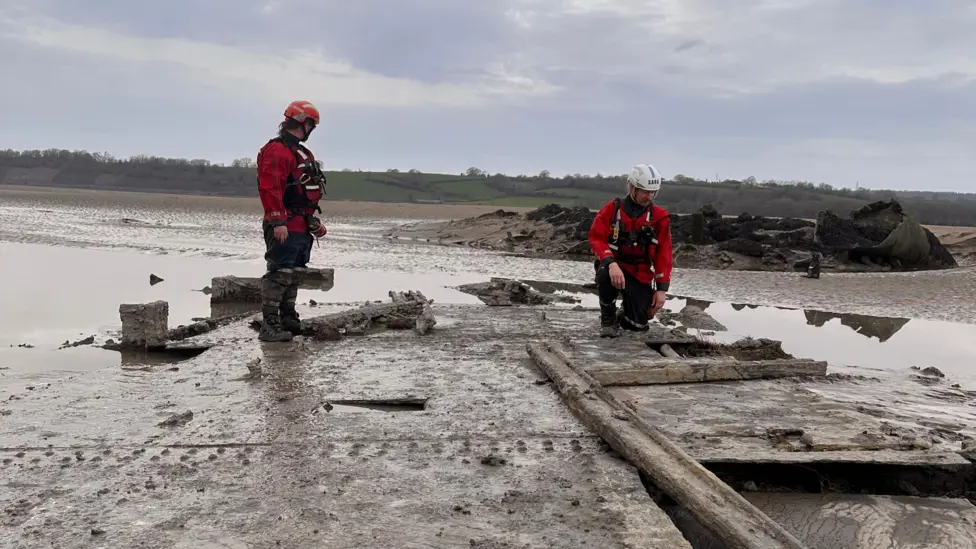
Lifeboat volunteers explore Severn Railway Bridge – which has lain under silt and mud for decades
Dramatic rain and low tides have uncovered parts of a railway bridge that was demolished after a disaster in which five men died.
The Severn Railway Bridge, which spanned the river between Sharpness and Lydney, was torn down after two barges disastrously struck the bridge in 1960. While parts of the structure are always visible at low tide, heavy rain during exceptionally low tides have washed away sediment – allowing Sharpness Lifeboat Station volunteers to explore the bridge during a rescue training session.
Crew member Luke Grinstead said it was "just fantastic" to have the opportunity to visit the remains of the bridge, which was built in the 1870s. "To actually have the opportunity to go out there, to stand on it, to touch it, and actually be in the environment that the workers were in when they built and demolished it was a privilege," he said.
The structure was partially destroyed in the Severn Railway Bridge disaster on 25 October, 1960, when two tankers carrying petrol and heating oil were caught in dense fog and driven upriver.
They collided and, unable to separate, span together towards the bridge, hitting one of its piers – just minutes after the last train of the day had crossed. Flames then spread across the Severn when the petrol and oil cargo caught alight.
The two captains managed to swim to shore and an engineer was saved by men searching for the crew in a rowboat. However, the five remaining crew members did not survive.
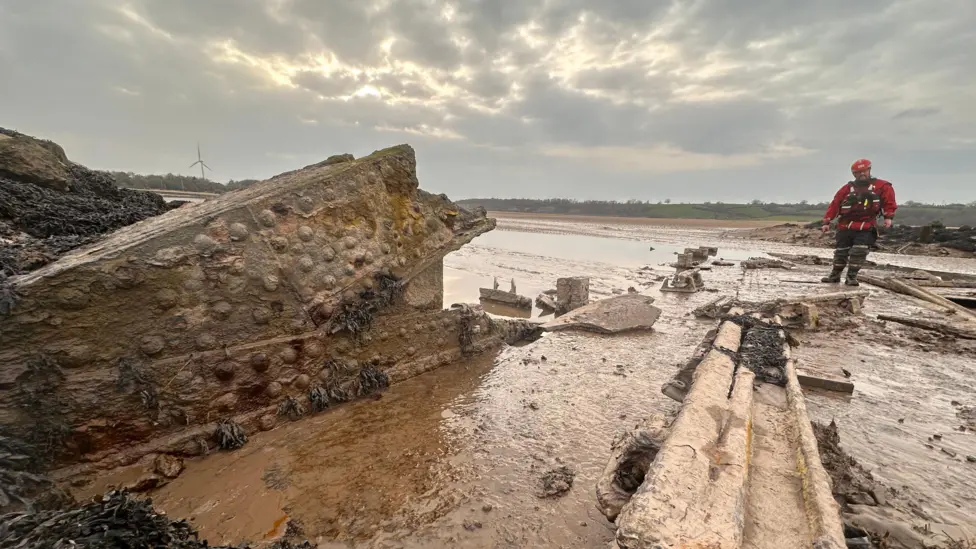
Remains of the railway bridge are strewn across the Severn riverbed
The bridge was demolished after the incident but remnants of the structure were left behind.
Rob Burrows, a volunteer at Sharpness Lifeboat Station, said he and other crew members made the most of a rare window of opportunity "to get out there". He said the bridge could have been quickly covered up again due to the equinox spring tides – which bring exceptionally high and low water levels.
Surges of water upriver caused by the Severn's strong tidal bore also tend to "reset things a bit", Burrows said. "Stuff gets exposed and it's very fragile – you see it once and then it's gone," he added.
Grinstead said it was "an exciting" and "challenging" trip overall. "I think it's just fantastic," he said. However, he warned any would-be explorers not to venture out to the remains due to the dangerous conditions.
Lifeboat volunteers explore Severn Railway Bridge – which has lain under silt and mud for decades
Dramatic rain and low tides have uncovered parts of a railway bridge that was demolished after a disaster in which five men died.
The Severn Railway Bridge, which spanned the river between Sharpness and Lydney, was torn down after two barges disastrously struck the bridge in 1960. While parts of the structure are always visible at low tide, heavy rain during exceptionally low tides have washed away sediment – allowing Sharpness Lifeboat Station volunteers to explore the bridge during a rescue training session.
Crew member Luke Grinstead said it was "just fantastic" to have the opportunity to visit the remains of the bridge, which was built in the 1870s. "To actually have the opportunity to go out there, to stand on it, to touch it, and actually be in the environment that the workers were in when they built and demolished it was a privilege," he said.
The structure was partially destroyed in the Severn Railway Bridge disaster on 25 October, 1960, when two tankers carrying petrol and heating oil were caught in dense fog and driven upriver.
They collided and, unable to separate, span together towards the bridge, hitting one of its piers – just minutes after the last train of the day had crossed. Flames then spread across the Severn when the petrol and oil cargo caught alight.
The two captains managed to swim to shore and an engineer was saved by men searching for the crew in a rowboat. However, the five remaining crew members did not survive.
Remains of the railway bridge are strewn across the Severn riverbed
The bridge was demolished after the incident but remnants of the structure were left behind.
Rob Burrows, a volunteer at Sharpness Lifeboat Station, said he and other crew members made the most of a rare window of opportunity "to get out there". He said the bridge could have been quickly covered up again due to the equinox spring tides – which bring exceptionally high and low water levels.
Surges of water upriver caused by the Severn's strong tidal bore also tend to "reset things a bit", Burrows said. "Stuff gets exposed and it's very fragile – you see it once and then it's gone," he added.
Grinstead said it was "an exciting" and "challenging" trip overall. "I think it's just fantastic," he said. However, he warned any would-be explorers not to venture out to the remains due to the dangerous conditions.
| Re: Severn Railway Bridge disaster - 25 October 1960 Posted by grahame at 10:53, 23rd October 2020 | |
https://www.bbc.co.uk/news/av/uk-england-gloucestershire-54651734
Wrecks visible in River Severn 60 years after disaster
It is 60 years since the Severn Railway Bridge disaster which saw two tanker barges - the Wastdale H and the Arkendale H - collide in fog near to Sharpness.
The two barges were then caught in the tide and collided with a railway bridge which collapsed. Five men lost their lives.
New drone footage gives us a close-up view of the remains of the shipwrecked vessels.
It is 60 years since the Severn Railway Bridge disaster which saw two tanker barges - the Wastdale H and the Arkendale H - collide in fog near to Sharpness.
The two barges were then caught in the tide and collided with a railway bridge which collapsed. Five men lost their lives.
New drone footage gives us a close-up view of the remains of the shipwrecked vessels.
| Re: Severn Railway Bridge disaster - 25 October 1960 Posted by eightf48544 at 10:53, 25th October 2010 | |
A very interesting account of great tragedy.
"The bridge destruction that night severed more than a rail link. A close affinity had existed between the communities on both sides of the Severn but the disaster severed friendships, business and education connections for good. The social perspective switched from the Forest of Dean towards the Cotswolds.
It changed my life, too, and that of dozens of other youngsters from my home village Sharpness, nearby Berkeley, and surrounding Severn Vale villages."
We had been pupils at Lydney Grammar School, catching the two-coach, non-corridor service, hauled by a little GWR tank engine, every morning. The service chugged its way from Berkeley Road station, on the Bristol-Birmingham main line, through Berkeley, Sharpness, Severn Bridge Halt (perched precariously on the end of the railway viaduct) to Lydney. For the next couple of years school would be an 80-mile-plus daily round trip.
It illustrates how a rail link becomes embedded in a community and shapes social interactions. I had heard the story of the bridge from our pilot on Severn who had just started at Lydney school that September and used the train. He confirmed BR did try running a train round via Gloucester but it took 2 hours.
Eventually Gloucester CC were forced to use a school on the Sharpness side.
"And what of the bridge? It was doomed. Its gaping hole was never repaired and, eventually, it was demolished."
Unfortunately it was a time rail was considered irrelevant and so no money was forthcoming for repair. Particularly although used when the Severn Tunnel was closed it could only take a Dean Goods and certainly not not a King or Castle or even a Manor. So involved two engine changes for trains two and from South Wales.
Had rail been more in favour the bridge could probably have been rebuilt to take larger locos and be there today as a the faster/shorter link to South Wales when the tunnel is closed. More so if the Eastbound curve at Yate/Westerleigh were reinstated.
A great tragedy and an fascinating piece of Social History.
Thanks for posting it.
| Severn Railway Bridge disaster - 25 October 1960 Posted by JayMac at 08:43, 25th October 2010 | |
From the Bristol Evening Post:
Western Daily Press features editor Tim Davey recalls the night half a century ago when the River Severn turned into an inferno, destroying a crucial rail link.
Avonmouth Docks on the evening of October 25, 1960: the Wastdale H, a small oil tanker, slips from her berth. Across the other side of the Bristol Channel, another tanker from the same fleet, the Arkendale H, leaves Swansea. Their destination is the port of Sharpness further up the River Severn. One tanker is loaded with crude oil, the other petrol. Little could their crews have guessed as they embarked on these innocuous voyages that neither craft would ever reach its destination. Instead, they would become the leading players in a disaster the like of which had never been envisaged.
Lying like an impenetrable shroud along the banks of the swift-flowing Severn that night was a dense fog. For the unsuspecting crews, first light would find five of them dead, their vessels wrecked, and a famous railway bridge in ruins. As they passed the nuclear power station at Berkeley, the two tankers encountered the thick fog. Close by, the fog siren signalling the entrance to Sharpness Docks was wailing its warning. Entering this rural port was a far from straightforward manoeuvre, even at the best of times. In this thick fog it was just about to take on a nightmarish dimension for the crews on both tankers.
Effectively, they both missed the entrance, eventually becoming locked together. Drifting on the notorious Severn currents, the Arkendale and Wastdale were swept up river. They smashed into the Severn railway bridge, a 21-span structure almost a mile long and linking Sharpness with the Forest of Dean. Ominously, this bridge also carried a gas main...
The blast that followed, at 10.25pm, destroyed two of its 171-foot spans and reduced their huge support to a four-foot high stub. Fuel which had spilled from the tankers ignited. The Severn was ablaze and flames stretched two miles downstream.
The nightmare scenario increased as locals living riverside could hear the crew's cries from this floating inferno.
Some 20 years ago or so I spoke with a Sharpness resident who remembered the incident vividly. Dick Sollars was a former a bridge man at Sharpness Docks and was waiting for the two tankers to arrive.
"I heard a tremendous explosion, like the sound of jet plane. The whole sky lit up and there was then a series of explosions, a deep seated roar, " he recalled. "The heat was so intense it lifted the fog on that stretch of the river. The flames didn't die down until 3am."
A goods train had been due on the bridge at the time of the blast, but had fortunately been cancelled. And a night maintenance team of railway workers had also been due on the bridge, but survived because they stayed in a junction box at Lydney, listening to the end of a boxing match on the radio.
Three men survived from the tankers, including both skippers.
Charlie Henderson had not set eyes on the Severn until the day of the tanker tragedy. He was then aged 28 and it was his first day at a new job in Berkeley power station, which stands alongside the river. He had never rowed a boat, either, but that night he was to become a hero. With Tommy Carter, skipper of another tanker moored at Sharpness, Mr Henderson took a rowboat out on the swiftly ebbing estuary to search for survivors.
For two-and-a-half hours they searched. He told reporters at the time: "It was awful. We got lost in the fog and only had the light from the burning oil to guide us. We had to pull in shore once and steer clear of blazing debris. It was then we heard some strong cries for help."
They found the injured man, and pulled him on board.
And what of the bridge? It was doomed. Its gaping hole was never repaired and, eventually, it was demolished.
The bridge destruction that night severed more than a rail link. A close affinity had existed between the communities on both sides of the Severn but the disaster severed friendships, business and education connections for good. The social perspective switched from the Forest of Dean towards the Cotswolds.
It changed my life, too, and that of dozens of other youngsters from my home village Sharpness, nearby Berkeley, and surrounding Severn Vale villages.
We had been pupils at Lydney Grammar School, catching the two-coach, non-corridor service, hauled by a little GWR tank engine, every morning. The service chugged its way from Berkeley Road station, on the Bristol-Birmingham main line, through Berkeley, Sharpness, Severn Bridge Halt (perched precariously on the end of the railway viaduct) to Lydney. For the next couple of years school would be an 80-mile-plus daily round trip.
However, a stark reminder of that horrendous night of death and destruction on the Severn, is still there to this day. Low tide reveals the hulks of the two tankers lying next to each other on a sandbank in the middle of the river near the spot where the, now demolished, bridge once stood.
It seems incredible, looking back, that someone would give a bunch of teenagers their very own door-to-door train service. Yet that's precisely what Gloucestershire County Council did half a century ago. Every morning we assembled, variously, at Sharpness and Berkeley railway stations to catch the little local train that went as far as Berkeley Road, where the connection was made with the Bristol-Gloucester mainline. There, every weekday in term time, the mighty Pines Express, which normally roared straight through en route to Manchester from Bournemouth would be forced to a grinding halt at this country station, while us kids clambered on board. There we sped off to Gloucester Eastgate, before crossing the bridge to Gloucester Central and catching yet another train all the way to Lydney Junction. There we alighted and were taken by coach to Lydney Grammar School.
Every afternoon, however, we entered a more exclusive sort of rail travelling class. One on a par, though not comfort, with those who can call upon the Royal train, as Prince Charles did recently here in the West. Our train was a more modest affair, an ancient two-coach, non-corridor number, pulled by a GWR tank engine. We boarded at Lydney Junction but, this time, the train ran non-stop up one side of the Severn's banks and down the other. There were no toilets on the train, though: don't ask!
I do recall that at some stage, though not initially, we were locked in each separate compartment. Health and safety didn't come into it. But we didn't mind. We had fun, fun, fun, in the manner that unsupervised school kids would do. We used the luggage racks as sleeping bunks and then some wag, obviously good at woodwork, discovered you could actually link the compartment, simply by unscrewing the wooden fascias. It was ingenious, as it enabled us to pass various objects up and down a train with no corridors. I won't dwell, either, on some of the items that were passed. It was like a St Trinian's charter for girls ^ and boys.
For a number of school terms we never attended a school assembly, nor ever went to the last lesson of each day. It couldn't go on and didn't. Some number-crunching educationalist pulled the plug on our little train and despatched us to fresh fields of academe, namely, in the most part, Dursley Grammar School.
Tim Davey
Avonmouth Docks on the evening of October 25, 1960: the Wastdale H, a small oil tanker, slips from her berth. Across the other side of the Bristol Channel, another tanker from the same fleet, the Arkendale H, leaves Swansea. Their destination is the port of Sharpness further up the River Severn. One tanker is loaded with crude oil, the other petrol. Little could their crews have guessed as they embarked on these innocuous voyages that neither craft would ever reach its destination. Instead, they would become the leading players in a disaster the like of which had never been envisaged.
Lying like an impenetrable shroud along the banks of the swift-flowing Severn that night was a dense fog. For the unsuspecting crews, first light would find five of them dead, their vessels wrecked, and a famous railway bridge in ruins. As they passed the nuclear power station at Berkeley, the two tankers encountered the thick fog. Close by, the fog siren signalling the entrance to Sharpness Docks was wailing its warning. Entering this rural port was a far from straightforward manoeuvre, even at the best of times. In this thick fog it was just about to take on a nightmarish dimension for the crews on both tankers.
Effectively, they both missed the entrance, eventually becoming locked together. Drifting on the notorious Severn currents, the Arkendale and Wastdale were swept up river. They smashed into the Severn railway bridge, a 21-span structure almost a mile long and linking Sharpness with the Forest of Dean. Ominously, this bridge also carried a gas main...
The blast that followed, at 10.25pm, destroyed two of its 171-foot spans and reduced their huge support to a four-foot high stub. Fuel which had spilled from the tankers ignited. The Severn was ablaze and flames stretched two miles downstream.
The nightmare scenario increased as locals living riverside could hear the crew's cries from this floating inferno.
Some 20 years ago or so I spoke with a Sharpness resident who remembered the incident vividly. Dick Sollars was a former a bridge man at Sharpness Docks and was waiting for the two tankers to arrive.
"I heard a tremendous explosion, like the sound of jet plane. The whole sky lit up and there was then a series of explosions, a deep seated roar, " he recalled. "The heat was so intense it lifted the fog on that stretch of the river. The flames didn't die down until 3am."
A goods train had been due on the bridge at the time of the blast, but had fortunately been cancelled. And a night maintenance team of railway workers had also been due on the bridge, but survived because they stayed in a junction box at Lydney, listening to the end of a boxing match on the radio.
Three men survived from the tankers, including both skippers.
Charlie Henderson had not set eyes on the Severn until the day of the tanker tragedy. He was then aged 28 and it was his first day at a new job in Berkeley power station, which stands alongside the river. He had never rowed a boat, either, but that night he was to become a hero. With Tommy Carter, skipper of another tanker moored at Sharpness, Mr Henderson took a rowboat out on the swiftly ebbing estuary to search for survivors.
For two-and-a-half hours they searched. He told reporters at the time: "It was awful. We got lost in the fog and only had the light from the burning oil to guide us. We had to pull in shore once and steer clear of blazing debris. It was then we heard some strong cries for help."
They found the injured man, and pulled him on board.
And what of the bridge? It was doomed. Its gaping hole was never repaired and, eventually, it was demolished.
The bridge destruction that night severed more than a rail link. A close affinity had existed between the communities on both sides of the Severn but the disaster severed friendships, business and education connections for good. The social perspective switched from the Forest of Dean towards the Cotswolds.
It changed my life, too, and that of dozens of other youngsters from my home village Sharpness, nearby Berkeley, and surrounding Severn Vale villages.
We had been pupils at Lydney Grammar School, catching the two-coach, non-corridor service, hauled by a little GWR tank engine, every morning. The service chugged its way from Berkeley Road station, on the Bristol-Birmingham main line, through Berkeley, Sharpness, Severn Bridge Halt (perched precariously on the end of the railway viaduct) to Lydney. For the next couple of years school would be an 80-mile-plus daily round trip.
However, a stark reminder of that horrendous night of death and destruction on the Severn, is still there to this day. Low tide reveals the hulks of the two tankers lying next to each other on a sandbank in the middle of the river near the spot where the, now demolished, bridge once stood.
It seems incredible, looking back, that someone would give a bunch of teenagers their very own door-to-door train service. Yet that's precisely what Gloucestershire County Council did half a century ago. Every morning we assembled, variously, at Sharpness and Berkeley railway stations to catch the little local train that went as far as Berkeley Road, where the connection was made with the Bristol-Gloucester mainline. There, every weekday in term time, the mighty Pines Express, which normally roared straight through en route to Manchester from Bournemouth would be forced to a grinding halt at this country station, while us kids clambered on board. There we sped off to Gloucester Eastgate, before crossing the bridge to Gloucester Central and catching yet another train all the way to Lydney Junction. There we alighted and were taken by coach to Lydney Grammar School.
Every afternoon, however, we entered a more exclusive sort of rail travelling class. One on a par, though not comfort, with those who can call upon the Royal train, as Prince Charles did recently here in the West. Our train was a more modest affair, an ancient two-coach, non-corridor number, pulled by a GWR tank engine. We boarded at Lydney Junction but, this time, the train ran non-stop up one side of the Severn's banks and down the other. There were no toilets on the train, though: don't ask!
I do recall that at some stage, though not initially, we were locked in each separate compartment. Health and safety didn't come into it. But we didn't mind. We had fun, fun, fun, in the manner that unsupervised school kids would do. We used the luggage racks as sleeping bunks and then some wag, obviously good at woodwork, discovered you could actually link the compartment, simply by unscrewing the wooden fascias. It was ingenious, as it enabled us to pass various objects up and down a train with no corridors. I won't dwell, either, on some of the items that were passed. It was like a St Trinian's charter for girls ^ and boys.
For a number of school terms we never attended a school assembly, nor ever went to the last lesson of each day. It couldn't go on and didn't. Some number-crunching educationalist pulled the plug on our little train and despatched us to fresh fields of academe, namely, in the most part, Dursley Grammar School.
Tim Davey
The website River Severn Tales has a lot of interesting detail, including photos and a Gloucestershire Fire Service report.
